
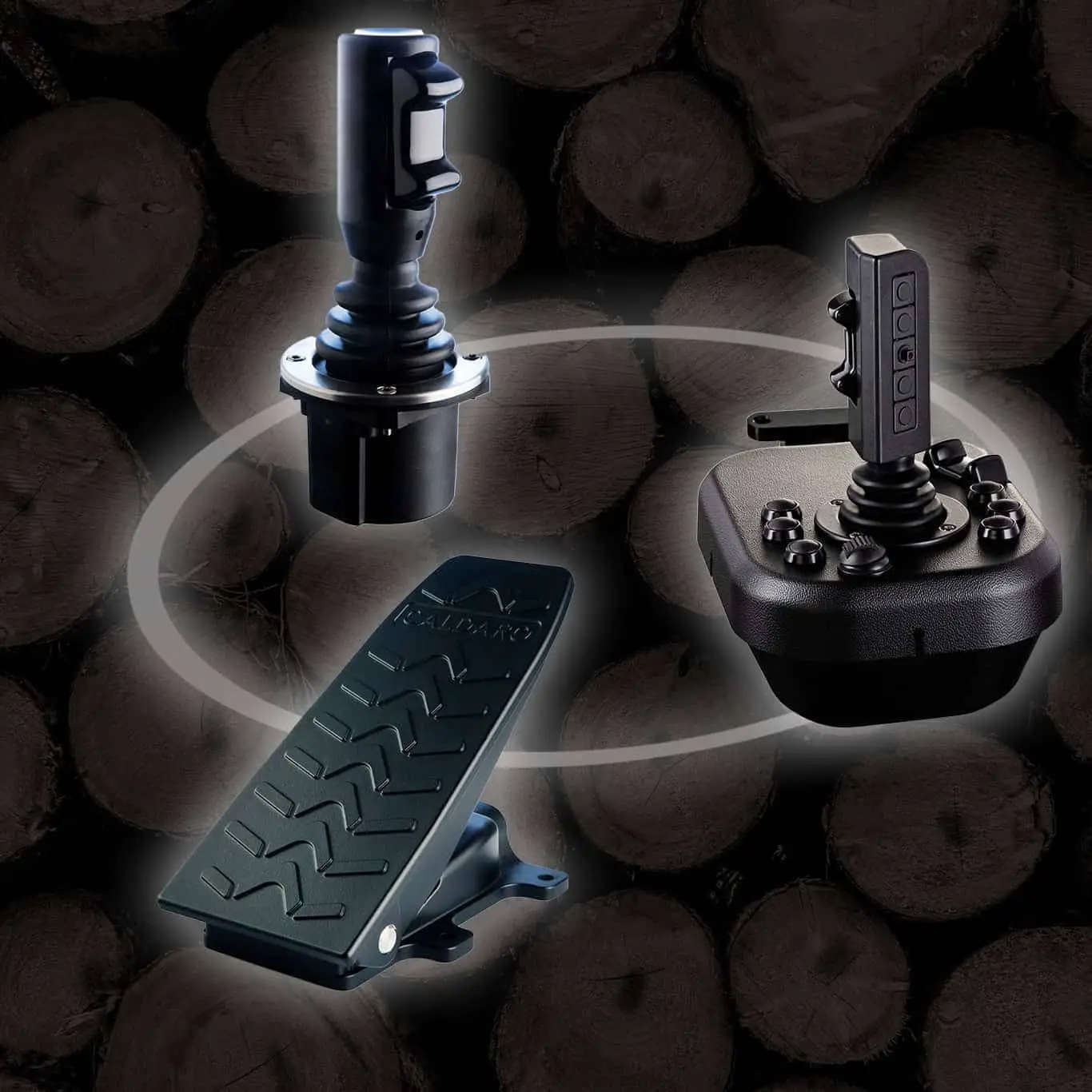
When customers asked for full CAN functionality on the existing C15 joystick, which is quite small, Caldaro accepted the challenge to incorporate all additional electronics onto the existing 37 mm circuit board. This was difficult as it already carries dual redundant sensor circuits for the two main axes of control.
The Finnish company Technion creates electronic control systems for mobile machines. They asked the Swedish company Caldaro if they could integrate CAN inside the C15 joystick.
”We have supplied joysticks with CAN for many years,” explains Patrik Widstrand, Sales Manager at Caldaro, ”but we used to buy readymade CAN interface cards and attach them to the bottom of the existing joystick, which was a clunky solution. What if we could offer a joystick with the card embedded inside, without making the joystick any larger?”
Now Caldaro has built their own CAN interface and incorporated it into the compact design of their C15 joystick. This simplifies the assembly with fewer cables, makes it easier to mount in a machine, and is more robust. The electronics are extremely well protected from both vibration and moisture, thanks to being encapsulated inside a silicon filled housing.
The CAN joystick and the xCrane PRO control system
To construct a big forestry crane with a long reach is a substantial test on the steering control system. Thanks to CAN technology each hydraulics controller can be mounted near the valve block. Removing unneeded cables greatly enhances reliability. Technion’s new xCrane PRO crane control system is the first application of Caldaro’s new CAN joystick.
“The traditional crane control means that each cylinder is controlled with one joystick movement,” says Toni Lomakka, Sales Manager at Technion. ”Our xCrane PRO brings crane operations to a completely new level with state-of-the-art tip control. Operators can now control the tip of the boom instead of controlling each cylinder separately. The crane operations become easier, faster and more intuitive.”
“The operator can perform precise movements even with long reaches,” explains Lomakka. ”The crane tip moves at a smooth, constant speed regardless of the outreach, and the control system automatically slows down the speed in the end positions.”
When many actuators work seamlessly together, the operator experiences easier and smoother control, which in turn increases productivity.
“This also means that fuel consumption decreases and even the machine operator saves his energy,” says Lomakka.
Making it easier to fulfil future safety demands
Caldaro has in fact developed an entire technical platform for easily adapting functionality to meet specific customer requirements. This includes the creation of hardware and software that run automated tests that in just days simulate a huge number of scenarios, including many that you typically won’t encounter in traditional field testing.
“All hardware has passed systematic tests before it gets incorporated into a joystick.” explains Petter Löfgren, Technical Manager at Caldaro. ”To make it even safer, we implemented duplicate processors, which made the challenge more difficult yet. The new CAN card is armed with two powerful 32-bit processors.”
Caldaro aims to be one step ahead in product safety. this includes making the CAN joystick future-proof.
“The new CAN hardware is designed to meet extremely tough safety requirements,” continues Löfgren. “As soon as we are ready with the software and have verified the product with compliance testing, we can offer ISO 13849 Pl-d/CAT3 electronics in all our joysticks and pedals.”
—
This article is also published in IVT International March 2021